

UDR Foolishness
By Gaurang
March 8 2011
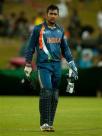
The Umpire Decision Review System or UDRS as implemented by the ICC in this World Cup is showing that the system has some major flaws, one of which the Indian captain Mahendra Singh Dhoni pointed out in quite colorful language. He rightly called the farcical decision by umpire Billy Bowden to stick with his initial call of not out even though the evidence from Hawkeye showed the ball basically crashing into middle and off stump as an “adulteration” of human and machine decision making.
There is no question in anyone's mind that if the point of impact on the pad is very close to the stumps, then Hawkeye is very, very accurate, and that the further you get from the stumps, it's accuracy decreases. However the way the ICC rules are currently written it unecessarily introduces human bias into the decision.
The ICC rules basically state that if the point of impact is 2.5 meters or more from the stumps, there is inaccuracy and so the onfield umpires decision is what counts. However, the ICC recognized that in a couple of circumstances despite the inaccuracy of Hawkeye beyond 2.5 meters, it may still give the right decision.
As I understand it, the two exceptions are first, if the initial decision was not out, but Hawkeye showed the ball hitting middle stump dead on, then the on field umpire should change his decision to out. Second, if the initial decision is out, but Hawkeye showed the ball to be completely missing any of the stumps then the on filed umpire should change his decision.
On the face of it this sounds like a decent compromise, but if you delve deeper, it shows contradictory levels of confidence in Hawkeye's accuracy at 2.5 meter or more. In the first case, like the Ian Bell decision, for Billy Bowden's initial on field decision of not out to be ruled out the ICC rule required that Hawkeye showed the ball to be hitting middle stump. But if the ball hit middle and off stump, as in the case of the Bell decision the batsman is not out. In other words it says that Hawkeye can't predict that the ball would be hitting the stumps because there could be a margin of error of about 80-100 millimeters.
Now consider the second exception. where a batsman is given out LBW and Hawkeye shows that the ball would completely miss the stumps, even if by just a fraction of a millimeter, then the on field umpire would have to reverse his call. What this means is that here it is assumed that Hawkeye is accurate to within a margin of error of 2-4 millimeters, because a ball even just barely hitting the outside of either leg or off stump is out, but one missing it by just a touch is not out. These two scenarious show the utter foolishness of the rules the ICC has adopted.
What they should have adopted instead is a sliding scale of the margin of error (MOE) for Hawkeye based on the technical limitations of Hawkeye itself. For instance the scale could say that if the point of impact is less than 2 meters from the stump then Hawkeye's MOE = 0 and if the point of impact is more than 5 meters Hawkeye's MOE is 230 millimeters, i.e. the entire width of a standard wicket. In practicality this would mean that if the point of impact is less than 2 meters from the stump then whatever Hawkeye says goes, while if the point of impact is more than 5 meters then whatever Hawkeye says is irrelevant.
In all other situations, the MOE should be applied to the location that Hawkeye predicts the ball will hit or miss the wicket. If the MOE still allows for the initial umpire decision to stand then let that decision stand and if it does not, then overturn the on field umpire. End of story.
Actually, not quite the end of story, as the ICC has moved towards his more logical outcome, by amending their rigid rule, to now allow for the on field umpire's decision to be overturned if the ball was shown to be hitting any part of the middle stump, as was the case in the Bell decision.
Guess that will be some small comfort to Dhoni, but it still can't take away from the feeling that if Bell were given out, as he would have been under the amended rule, then India would most likely have won the game.
If you do not already have an account Click here to Register.
Edited 1 time(s). Last edit at 2011:03:08:21:26:48 by Birbal.
Just a couple of points: The rule was not amended after the Ian Bell not-out - ICC takes months to do virtually anything - in fact, they said during the commentary at the Ian Bell decision that this was the rule - Hawkeye hitting middle stump is still out even beyond 2.5 m.
Second point: if Hawkeye cannot be trusted after 2.5m, then why the heck would you trust the on-field umpire? Experience has shown that umpires repeatedly get LBW's wrong, so I would have a lot more faith in the accuracy of the Hawkeye than that of an umpire. For another thing, Hawkeye is guaranteed to be blind to the nationality or color of the batsman, and the importance of that cannot be overstated.
Edited 1 time(s). Last edit at 2011:03:08:23:29:33 by Anil.
Really pathetic how Bowden refused to acknowledge that he had screwed up big time... in giving Bell not out...
Making mistakes is human...not correcting them is called BIAS...
Agree with you second point... I'd go with Hawkeye too..
Quote:Birbal
So they only "clarified" the rule...
Really pathetic how Bowden refused to acknowledge that he had screwed up big time... in giving Bell not out...
Making mistakes is human...not correcting them is called BIAS...
Bowden is as crooked as his finger. He will never correct himself regardless of how much technology you show him.
But more than him, I blame the third umpire - did he not know the rule that the viewers were being told about?
Or did he not see the Hawkeye results that the viewers were seeing, that of the ball striking middle stump?
Why should he be allowed to keep making the big bucks after screwing up the one and only job he was called upon to do for the entire match?
One big advantage of UDRS certainly is to keep the ICC umpires honest. Knowing their decisions can be appealed will improve their decision-making automatically. Less of England-Australia bhai-bhai etc.
Now, the new technologies need to be factored in.

According to Dave Richardson of ICC,
These are the guidelines which have been given to the umpires:
(a) If both the 40cm and 2.5m graphics appear for the same delivery, the batsman will definitely remain NOT OUT.
If the "MORE THAN 2.5m" graphic appears without the 40cm, the third umpire will be informed by Hawk-Eye of the exact distance of impact from the stumps.
(b) If this distance is greater than 3.5m, the batsman will definitely remain NOT OUT.
(c) If this distance is greater than 2.5m and not more than 3.5m, the third umpire is to advise the on-field umpire to overturn a NOT OUT decision when some part of the ball (as presented by Hawk-Eye) is hitting the middle stump AND the whole of the ball is hitting the stumps below the bottom of the bails.
(d) If the ball is not hitting within the parameters outlined in (c) above, the batsman will remain NOT OUT.
For (c) and (d) above, the third umpire will make the judgment by viewing Hawk-Eye from above and side-on, and advise the on field umpire the exact distance, view from side on and the on field umpire will actually make his decision based on this additional information provided by the third umpire, as set out above.
Mr Richardson said: "This is not a change in rules as some people have suggested but a broad guideline which we hope will bring a consistency to the decision making."
Just look at this chutiya clarification, it's all in the negative. It talks only about NOT OUT.
How about clarifying when it's OUT, you barstard? Wasn't that the point of UDRS, to find when a batsman is out? Wasn't that what Dhoni was complaining about?
Appealing an umpire's decision makes no sense if the same umpire makes the decision.
This is an appeal system in which the accused becomes the judge.
That is what Dhoni was saying...
Edited 1 time(s). Last edit at 2011:03:11:15:54:30 by Birbal.
Still this FOOLISHNESS now with Hot Spot... is going on...
What a joke...
This is not right. Even if it's close to stumps, it's not accurate. It projects better that's all. Only way you can get accurate projection is when you create the path using historical data along with current pointers.Otherwise it is guess work at best. This is a simple definition of 'projection'. hawkeye is uncooked acdameic kind of technology project that is probbaly developed as PoC and rolled out in production as it is.
Hawkeye in tennis is different becasue the ball has ACTUALLY hit the spot - It's not same projection as we are trying to use in cricket where ball goes dead after hitting pads or becomes irreleant after hitting pads.
I'll be safe, hanging out with Elvis on the Mars base.
It was painfully obvious where the improvements were needed even back when this incident with Ian Bell happened...but it has taken till now for the ICC to improve the system.
There is still ONE BIG ISSUE... which they have not addressed though they have danced around it...
That is the issue of "umpire's call" decisions...
The ONLY logical way to address this while also keeping a role for the on field umpires is to allow a side that loses an "umpire's call appeal" to not NOT lose one of their two appeals....
after all if the UMPIRE WHO IS PAID TO DO THE JOB IS UNSURE
WHY PENALIZE THE SIDE APPEALING THE CALL IF THEY LOSE THE CALL?
The only reason this is not being done, is because the ICC probably still feels that the on-field umpire should not be questioned too much.
Well if the side questions clear decisions i.e. ones that are not umpire's call, then YES they should lose their right to an appeal...but if they question a decision that is 50/50 at best and the umpire is not sure...i.e. it's an "umpire's call" then why should they be held to a higher standard than the umpire?
Also by eliminating this penalty, any BIAS by an umpire will be quickly exposed... eliminating the penalty for a side losing an appeal on an umpire's call should be implemented IMMEDIATELY.
The dancing around the issue that ICC has done is to reset the 2 appeals every 80 overs... which in practical terms allows a side that has lost both its appeal to regain them if they stay out in the field long enough.
But this is not a satisfactory solution. An umpire could give two marginal decsions against a side and the side that appeals both in the first 10 overs...will lose both appeals...then for next 70 overs they have no appeals left...and the umpire who is BIASED against them can give both marginal and even howler type decisions against them with no recourse by the side that lost its two appeals early.
Edited 1 time(s). Last edit at 2016:10:24:21:18:04 by Birbal.
Apple: Ignoring Shilpa since 27/3/2012 and Birbal (temporarily replying to him since there's no one else here 26/10/2015) since 16/8/2012
Quote:apple
Don't worry Birbal, I'm sure an "Arabian Gulf based businessman" i.e. a rich Indian whose taken his money out of Hindustan, will ensure that the umpire's call always goes India's way.
I see you are preparing the excuses for the ass kicking that is coming your way soon...
Edited 1 time(s). Last edit at 2016:10:25:21:32:12 by Birbal.
Quote:apple
Don't worry Birbal, I'm sure an "Arabian Gulf based businessman" i.e. a rich Indian whose taken his money out of Hindustan, will ensure that the umpire's call always goes India's way.
loser's mindset.