

VVS: Sai ka Darshan
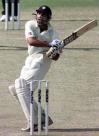
By Raul - 3 July '03
July 7 2003
The art of batting seems to come easily to some people. Sometimes ridiculously easily to batsmen like 27-year-old Vangipurappu Venkata Sai Laxman (named after the miracle-working Sai Baba of Shirdi).
His parents, both doctors, would have loved their son to be a surgeon. He did end up becoming one, albeit on the cricketing field, wielding his willow with surgical precision and dispatching all kinds of bowling to the boundary at will.
Growing up in Hyderabad, Laxman used to play badminton and table tennis but cricket was closest to his heart. It was his uncle B. Krishna Mohan who groomed the cricketer in him, fine-tuning his batting philosophy and providing the young boy much-needed encouragement.
As a seventh standard student, Laxman honed his skills at the St. John's Coaching Camp in Hyderabad. He soon became a permanent member of the Hyderabad under-16 team, and one day, he met former Indian captain Mohammed Azharuddin. Today, although he readily acknowledges the former skipper’s role in grooming his cricketing skills, Laxman declines that he ever modeled himself on Azhar, who was disgraced by the betting and match-fixing scandal, but some of his strokes have the same grace and wristiness about them.
By the time Laxman made his Test debut, he had already made a big mark in domestic cricket and impressed one and all with his temperament and timing. Catapulted into the big league of Test cricket, he continued to impress, though a couple of years down the road, he had still failed to cement his place in the team. This was not entirely his fault, as the selectors had converted him from a middle-order batsman to an opener.
Although Laxman himself had misgivings about opening the batting, he did it out of pragmatism, since it was hard to break into a middle-order featuring Dravid, Tendulkar, Azharuddin and Ganguly. But converted openers have rarely succeeded in the long term, with a few notable exceptions like Justin Langer.
His swashbuckling 167 at Sydney notwithstanding, Laxman never did justice to his ample willow-wielding talent in the opener’s slot. With a penchant for wristy on drives like Azharuddin, he tended to play across the line a bit. This was exploited by bowlers who could get some early movement and Laxman’s Test batting average suffered as a result. He soon lost his place in the side to the likes of Deep Dasgupta and Shiv Sunder Das, considered “purer” openers by the wise men that mattered. Finally, he decided to bite the bullet and informed the selectors that he wished to be considered for selection only as a middle-order bat. In the context of Indian cricket, such a statement could have spelt the end of his career, since selectors rarely liked it to be pointed out that they screwed up. He went back to the nets, and worked towards correcting basic technical flaws without any apparent help or advice from peers, seniors or coaches in this regard.
He announced his readiness to re-enter the big stage with a terrific triple century against a then-current Test bowling line-up of Dodda Ganesh, Venkatesh Prasad and Sunil Joshi. With a middle-order spot vacant since Azharuddin’s ignominious exit from all cricket, Laxman was rewarded with a place in the squad picked to play the all-conquering Aussies who were on a 15-match winning streak. When he took guard against Shane Warne in the First Test at Wankhede, he knew how important it was that he prove himself all over again to his fans and detractors alike. He played himself in patiently, eschewing all risks, but was dismissed by a clever piece of bowling by Glen McGrath. The rest of the batting fell apart and India soon capitulated to hand Australia its sixteenth consecutive Test win in less than three days.
Interestingly, many ex-players, including Gavaskar, had already observed some changes in Laxman’s game. He was batting much straighter and looked to be intent on staying at the crease than achieving complete domination over the bowling. (During the Bulawayo Test in the following away series in Zimbabwe, however, Sunil Gavaskar expressed the view that Laxman should bat straighter still).
Indian fans experienced a sense of deja vu through the first two innings of the next Test at Kolkata. Except for a brief flicker at the end of the Indian first inning where in the company of Venkatesh Prasad, Laxman took the attack to the Aussie bowlers and added a brisk 42 runs for the tenth wicket before being last out for a top score of 59 in a paltry total of 171.
On his way back to the dressing room after the first inning, he was informed by the team management that he was going to play at number three in the second essay. Having played at number three through most of his career, he took the opportunity with both hands to create history. He started off pretty much where he had left off in the first innings, and ended the day on a stroke filled, unbeaten 109 that included 19 hits to the ropes, repeatedly caressing the ball between square point and extra-cover and playing wristy shots between square-leg and mid-on, seemingly at will.
More remarkable was the manner in which he played his strokes against the Aussie leg-spinner Shane Warne. He used his feet to perfection while driving the leggie to all parts of the fence which in fact upset the bowler’s rhythm. “I thought," said Shane Warne, "that there were only so many times that someone could come down the pitch and hit me out of the rough against the spin." He was wrong and famously so. “I went out to bat with a mission. A century was not on my mind. I just wanted to stick around and see that India reaches a safe position,” said Laxman.
Next morning, he came back, and in Rahul Dravid’s august company, went about building his epic knock studded with graceful straight drives, elegant flicks, powerful pulls and sharp cuts. As the sessions came and went, this outstanding exhibition of temperament, timing, batting artistry and undiluted class seemed to go on and on with no one witnessing it live wanting it to end, bar the bowlers who seemed completely clueless against Laxman. It didn’t matter what line or length they bowled—once Laxman decided that this one had to go, he would hit it to the boundary. At times, even the hapless Warne, McGrath, Gillespie or Kasprowicz stood and applauded at the sheer grace and poetry in the execution of those 44 boundaries. En route, Laxman was merely confirming that his enormous appetite for runs was no longer confined to domestic cricket. Strokes continued to flow from his bat in a continuous, delightful stream almost throughout his marathon innings that eclipsed many records including the highest ever Test score by an Indian batsman. Laxman's 281 ranks as one of the great Test match innings of all time, and at the end of that series, this sinewy right-hander averages 56 against Australia (despite the early struggles of his forced opener days). It should also not be forgotten that as an opener he also made 167 out of 261 against Australia in Sydney, the third highest percentage ever of a total innings.
This is what Jimmy Maher, Australia’s reserve opener, had to say about the Kolkata inning: “Laxman, tall and athletic, took risks no ordinary batsman should contemplate. Repeatedly, he stood tall and bashed seamers through the off-side with barely a hint of footwork. The doubters would argue a good eye and timing might work for such a man on the sub-continent but never where balls move about. They would do well to recall the buccaneering hundred he pillaged off the same crew barely 12 months earlier, in Sydney, of all places. Over seven and a half hours he and Dravid ignited a huge Calcutta crowd, first defying, then demolishing their opponents. Having come together with India four down and yet to force Australia bat again, Laxman smashed 281 and Dravid carved out 180. Certainly, Laxman rattled the bowlers and opened the door for his more refined team-mate but, equally, without Dravid there could have been no double century for the country's newest national hero.”
The following series in Zimbabwe, Laxman seemed to be suffering from having too many runs in his kitty, tending perhaps to find batting altogether too easy and unconsciously overlooking the need to make adjustments to suit local conditions. Most batsmen from the subcontinent tend to have problems adjusting to quicker, bouncier tracks abroad. At Bulawayo, for instance, Laxman perished to a ball that came to him too quickly for the pull shot he was trying to essay. In India, it would have been a four from the moment it left the bat.
Two unremarkable short series against South Africa and England followed (with a Test against Zimbabwe thrown in), with not too many chances to shine with the bat for Laxman. However, he came back strongly in West Indies, topping the Test averages at 76 and featuring as Man of the Match in India's Trinidad victory. He performed reasonably well in England and against the touring Caribbeans at home without having any outstanding knocks, save the top class century in the last Test against the West Indies at (no surprise!) Kolkata.
Like the rest of the top order (bar Virender Sehwag in the one-dayers), he had a nightmare of a tour to New Zealand on under prepared pitches. This was followed by more bad news: his non-selection for the World Cup squad despite his good performances in one-day cricket earlier against Australia, England and West Indies at home and in the Coca Cola Cup in Sri Lanka. Braving an injured knee, he had smashed a quick fire 87 to lead India’s charge to the finals. A reportedly fitter Dinesh Mongia was picked ahead of Laxman for the World Cup, ostensibly due to his better fielding and part-time bowling. One wonders what might have happened if VVS Laxman had joined up with Sehwag after the top order capitulated in the World Cup final. Would they have repeated Kolkata against the same team after the rain break? Would the Butcher of Najafgarh and the Wizard from Hyderabad have chased down an improbable target to create history?
Laxman’s batting style and approach reminds old-timers of some classy Hyderabad batsmen. Most of them were an aesthete's delight, but it was the taller batsmen among them, Jaisimha and Azharuddin, with whose batting styles Laxman's bears comparison. Jaisimha could thump the ball when the mood overtook him, but he had wrists of steel that he normally employed to stylish effect. Azharuddin's wristy batting style had considerable impact on Laxman's by his own admission, but he is no imitator. His offside play is so much more controlled and elegant than Azhar's whose on drives are admittedly peerless. He also hooks authoritatively unlike Azhar. And none of his predecessors could match his ability to concentrate for very long periods.
Of course, like most other great batsmen, Laxman does have his faults. He has a high back lift and he doesn’t move his feet too much, like Azharuddin. However, he tends to splay his feet much less than the former skipper when driving straight or through the off side and generally plays much straighter. Since he is blessed with a wonderful eye, he will attempt to punish anything slightly off line because of his proclivity for strokes square off the wicket on both sides. This tenders him susceptible to catches off the edge in the slips to cover point arc. He is a poor runner between the wickets and has his share of injury worries. He is also considered an average fielder, although in Test match cricket he is one of the better slip fielders India have had in a while.
Despite all this, “Very Very Special” Laxman has done an exceptional job for his team, more so in his second avatar as a middle-order bat. He can play fast bowling, which is the first test for anybody who hopes to play international cricket, he has a shot even to good balls which puts him in a much smaller group and he plays the pull shot which for some reason has been outlawed by most Indian batsmen.
And he can be breathtaking to watch. There is an edge-of-the-seat quality to his batting that will make him a major draw if he can carry even part of his consistency in domestic cricket to international cricket. The Yuvraj Singhs and the Mohammed Kaifs have their work cut out if they want to stake claim to his Test spot in the middle-order.
Quotable quotes from Laxman:
1. On the adjustments that a middle order bat like himself had to make while opening the innings:
“First and foremost you have to play the new ball. As a middle order batsman unless you're No.3 and an early wicket falls, you don't get to play the new ball. The most important difference is that you have to see off the shine, the bowlers are fresh and if you're batting first the wicket is fresh. Obviously there are some technical and temperamental adjustments to be made. You tend to leave more balls outside the off stump and just try to hang around more. Even if you're in good nick, you can't just go and play all your strokes. I feel the opening partnership is the most valuable partnership in helping the team get a big score. Once you have a stand of anything between 80-100, then it's likely the team will score between 350 and 400.”
2. On how he likes to spend time when not playing:
"I like listening to music, reading autobiographies of great sportspersons and personalities in general and hanging around with friends."
3. On whether he dreamed he would make history (after his 281):
“No.” (Pauses.) Really, who dreams up things like that?”
4. On successfully touring Australia:
“It's how you play the new ball. That is the key, because I believe that if the team has to do well in Australia, the opening stand is going to be very crucial. If you can see off the session from start of play to lunch, then the later order batsmen can play comfortably. So I feel that is a very important aspect, which we have to really think about, this thing of seeing the shine off without losing too many wickets. And, like I told you, the key is how quickly you adapt, since it is obviously going to be different conditions to what we are used to at home. And also, to succeed in Australia, you have to play positive cricket, you can't go on the defensive there.”
5. On the Barbados loss, chasing 121 to win:
“The wicket, one side of the wicket, was really horrible. There was a spot near the good length area, which was very dangerous, and they totally exploited that. We were expected to get that (121), but unfortunately Ambrose bowled really well. I think that was a big disappointment.