

Of Denied Victory and "Unique" Situations
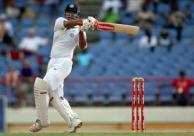
Sehwag was brilliant
By ICF Staff
June 15 2006
India piled up a massive first-innings total to put high pressure on the Windies, but conditions conspired to deny them a victory in a second consecutive match in which they found themselves in a winning situation on the final day.
Rahul Dravid's decision to bat on a St. Lucia pitch that initially appeared a greentop, but soon was exposed as a typical slow and low Windies track, saw India put up a monstrous 588/8 (decl) at the lively strike rate of 4 runs per over.
Virender Sehwag's brilliance made it possible, and his 180 at a run-a-ball built the platform for India's dominance throughout this match. Rahul Dravid and Mohammad Kaif hit more sedate centuries, while VVS Laxman and Yuvraj Singh failed again in the friendliest of conditions -- a pitch that held no terrors, and a bowling attack comprising unheralded pacemen Collins, Taylor, Collymore, Bradshaw, and Bravo (another poor Lara decision.)
As if Sehwag's effort with the bat were not already enough, he produced the goods with the ball as well, ending the Windies first innings with a return catch stunning in its brilliance, the best Indian bowler with 3/33. Munaf Patel and Anil Kumble did the rest. Bowled out for a lowly 215, the Windies lost their key batsman Chris Gayle twice in one day, and were headed towards a resounding innings defeat.
That the match should then have ended in a draw was driven by two major factors: the fourth day's play being washed out by rain, and the fifth day's play dominated by umpires intent on denying most appeals even as all Windies batsmen batted well out of their crease and kicked away numerous deliveries headed straight at the stumps.
If such a tactic was legal, then draws would be easy to secure. It is difficult to get the wicket of a batsman who has no intention of scoring, or of letting the ball through to the stumps.
However, standing outside your crease has never been a basis for being ineligible for LBW, and it should not have been a reason here. It is important that umpires Simon Taufel (Australia) and Asad Rauf (Pakistan) have their shocking performance in the second innings reviewed.
The ICC is unlikely to do that, however. Match referee Jeff Crowe (New Zealand) made his own bias clear when he refused to so much as reprimand Windies captain Brian Lara for throwing an unseemly fit on the field and challenging umpire Rauf in the previous match, but fining Virender Sehwag for celebrating the wicket of a batsman who had already started walking towards the pavilion without first looking at the umpire. In this match, Pedro Collins did that exact thing not once but twice, and the same referee, to add insult to injury, only reprimanded him.
The ICC has presented their oft-repeated excuse of "Unique Situations" to shield themselves against accusations of bias and inconsistency. They say that because each situation is slightly different from others, every similar act cannot be expected to be dealt with in the same manner.
This weak excuse is unlikely to be accepted in court, were the ICC to be hauled there to explain their numerous inconsistencies which regularly seem to find India on the receiving end.
Today, the ICC is perhaps the worst-organized body in world sports. Controversial and uncertain ICC laws open to variable and inconsistent interpretation needs revisiting and revamping. Unil such time as that happens, ICC will continue to be as confused an organization as it is now.
Look around and you will see innumberable controversies in cricket. Lack of good umpires, lack of clear laws to guide the umpires, the position of match referee being a waste of space, innumerable officials to officiate a match -- but not one game goes by devoid of controversy.
The umpiring is so poor that the use of neutral umpires has been defeated, but the ICC would never admit that. There are four umpires in each game, but most appear incapable.
Results in far too many games have been determined by twists and turns in the interpretations of rules by these umpires. An umpire known to consistently give a certain type of LBW in one game may consistently refuse to give it in another game, but never needs to justify it. He does get to report players who ask the mildest of questions about wrong decisions.
ICC is ruining the great sport by continuing to ignore the issues surrounding it, and releasing obtuse statements to support ridiculous decisions by their officials, rather than making an honest attempt to eliminate the loopholes.
Back to the second Test, India's inability to close out yet another match in which India dominated must be far more disappointing to the team members than to their fans.
Dravid's captaincy has lacked pride, emotion and passion. During the crucial final hour, as Windies tailenders stood up to vastly experienced Anil Kumble and a surprisingly penetrative Munaf Patel on a deteriorating pitch, he stood sedately at slips, a wooden expression on his face. Aloof as always, he was never seen geeing up his team, or providing a word of motivation or a tip to his inexperienced bowlers. Dropping a sitter in the dying moments did little to help his image. VRV Singh ran in and sprayed the ball around, wasting crucial overs, without a word of advice from the skipper -- his only redeeming factor being that he wasn't knocking out bails at non-striker end as often as in his debut in the previous match.
Issues of poor umpiring and poor selection have dogged India's chances in this series. There are two more Tests to go to in the series, although ICC's ridiculous ranking rules dictate that Windies is such a poor team, India will now lose ranking points even if they win both remaining matches and take the series 2-0.
The Windies may be one of the worst teams in the world, whipped by all and sundry in recent years, but they have been able to stave off defeat at the hands of one of the world's best teams. The draw may have been influenced by poor weather and umpiring, but it will go down in record as a draw, whether deserved or not.
To retain fan interest, it is incumbent upon the BCCI (and perhaps the ineffective ICPA players union) to address unfairness to its team on the field.
As the richest body in world cricket, and the source of most of ICC's revenue, BCCI is well-positioned to do so -- if only Sharad Pawar and Lalit Modi could find time off from persecuting the previous regime. They need to focus their energies squarely on cricket, rather than harassment of Jagmohan Dalmiya. Or trying harder than ever to increase their profits even beyond the many hundreds of millions of dollars they now make every year -- thanks to fan interest. It is high time they returned something to the cricketers and the fans.