

Hungary: Hungaroring Track Guide
By Phil Huff
July 22 2009
The Hungaroring has been a regular fixture on the GP calendar since 1986 when it became the first Formula One event to take place in Eastern Europe. Until recently, the circuit layout had remained the same since 1989, when an unplanned kink around an underground spring was removed, shortening the track and making it the second shortest lap on the current F1 calendar.
The twisty layout, with modifications made in 2003, also makes this the slowest circuit bar Monaco, and three corners (the Turn 2 and 13 hairpins, plus the Turn 6/7 chicane) are all 55mph (90kmh) turns. The fastest corner is the relatively modest 105mph (170kmh) left-hand kink at Turn 4.
Track temperature has a big influence on car set-up at the Hungaroring. If it’s relatively cool, as was the case in 2006, the overriding handling characteristic of a car is understeer; if it’s hot, it is oversteer. Almost invariably the weather has been hot during the race’s 22-year history, so the engineers will arrive at the track this week expecting oversteer and will seek ways of protecting the rear tyres during the 70-lap race.
The middle sector of the lap from Turn 4 through to the exit of Turn 11 gives the best indication of a car’s performance. The sector begins with a couple of slow corners, but ends with a very fast right-hander, which makes it hard to find a good balance. If a car’s quick through this sector, you can expect it to be quick around the whole lap.
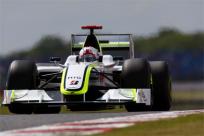
Fuel consumption is low, despite the high downforce levels, as only 55% of the lap is taken at full throttle; each lap should see the BGP001 use around 2kg of fuel, while the fuel effect (the extra time it takes to get round the circuit when heavier with fuel) is a significant 0.45s per 10kg of fuel.
At last year's event, the Honda Racing F1 drivers lined up a disappointing 12th and 17th place on the grid, with Button being ahead of Barrichello. The race was equally disappointing, with Button failing to make up any places, and Rubens rising just one position to finish in 16th.
Back in 2006, Jenson Button took victory from fourth on the grid in a rain affected race, acquiring his first Formula One win, and Honda Racing F1's first win since 1967.